|
|
|
Freezer
aus Börnicke
offline


Enhanced OC
23 Jahre dabei !
AMD Athlon 64
2000 MHz @ 2520 MHz
-34°C mit 1.82 Volt
|
       
Hab noch etwas zu den Terminen gefunden:
Intel Corporation may accelerate the transition to land grid array processor packaging and launch the new platforms supporting DDR-II and PCI Express as early as in the very late first quarter, web-site X86-secret.com revealed today.
According to the report, Intel may formally launch its Grantsdale-P, Grantsdale-G and Alderwood chipsets on the 29th of March 2004 – in the very later first quarter. The information was not confirmed by our sources directly, but they mentioned that the 28th of March is the first day when the new chipsets are listed in Intel’s official core-logic pricelist at $38, $42 and $50 price-points respectively. This may mean that the company will begin the shipments of its Grantsdale-P, Grantsdale-G and Alderwood products in late March and will immediately announce the availability of the novelties.
It is not absolutely clear when the new mainboards powered by the new chipsets will actually emerge on the market.
LGA775 aka Socket T will not be an ordinary CPU socket, but will utilise new land grid array (LGA) connector type which permits direct electrical connection between a module substrate and a mainboard. It is bit complex type of socketing, but it allows making CPUs with higher density of pins keeping the costs of such devices at levels suitable for mainstream computing. Additionally, LGA775 is better suitable for processors with higher power consumption and core-clock. According to Intel, Pentium 4 SSE3 processors with speeds from 3.80GHz and above will be LGA only. Initial code-named Prescott chips will debut in Socket 478.
The first LGA775 processors are expected to debut in Q2 2004. However, in case the report from X86-secret.com is correct, we may see actual chips in the new form-factor already in late March 2004.
The Pentium 4 with SSE3 technology LGA775 CPUs made using 90nm fabrication process will be clocked at 2.80 GHz, 3.00GHz, 3.20GHz, 3.40GHz and 3.60GHz, will sport 800MHz PSB, incorporate 1MB cache and will be priced at Intel’s general mainstream and high-end pricing. Moreover, in order to further popularize the LGA775 form-factor, Intel adds 3.80GHz chip with 800MHz Quad Pumped Bus in the high end and 2.80GHz CPU with 533MHz QPB in the mainstream sections sometime in Q3. The latter CPU will probably become an interesting option for mainstream computers at $800-$999. Sources close to the chipmaker also believe there will be a plethora of Celeron microprocessors for Socket T.
Danke schoen an Xbitlabs die den Artikel verfasst haben! 
I feel the minute of decay -
|
Beiträge gesamt: 487 | Durchschnitt: 0 Postings pro Tag
Registrierung: Jan. 2003 | Dabei seit: 8701 Tagen | Erstellt: 8:02 am 13. Feb. 2004
|
|
kammerjaeger
aus Versehen
offline


Real OC or Post God !
23 Jahre dabei !
Intel Core i3
3100 MHz mit 1.10 Volt
|
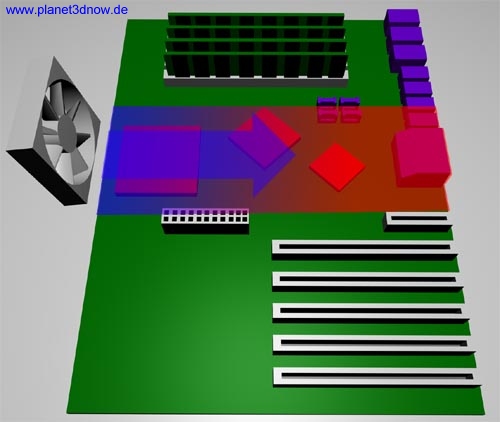
Mir ist noch nicht ganz klar, wo wirklich die Vorteile liegen sollen. 
- Das der CPU-Bereich direkt mit frischer Außenluft gekühlt wird, erreichen einige Gehäuse schon mit Trichtern in der Seitenwand.
- Die Kühlung der Grafikkarte kann ebenfalls von der Seite erfolgen. Nachteil bei BTX scheint nämlich zu sein, daß auch hier die Rückseite der Grafikkarte praktisch ungekühlt bleibt, einige Karten werden aber gerade an der Rückseite enorm warm...
- Die Kühlung der Festplatte wird völlig außen vor gelassen. Beim aktuellen Standard kann mit dem Front-Lüfter gleich die Platte gekühlt werden, bei BTX scheint man sich dafür nicht zu interessieren. Daher sollten auch die Komponenten, die nicht auf dem Board sitzen, in ein solches Layout einbezogen werden, statt sich nur auf die Board-Komponenten und Grafik zu konzentrieren.
- fast 100% aller "Supermarkt"-Komplett-PC´s werden sogar ohne Frontlüfter verkauft. Trotzdem ist es möglich, diese leise zu kühlen. Wozu also ein neues Format für den Mainstream-Bereich?
Meinen aktuellen Download-PC und LAN-Ersatz-PC (Duron 1600@11x166 @1,3V auf Nforce2 IGP mit GF4MX) hab ich einen 7cm hohen, alten CD-Player eingebaut. Es geht also auch mit aktuellen Formaten, selbst ohne die teuren FlexATX oder VIA-Eden/Epia-Boards...
Lediglich an vernünftigen Low-Profile-Karten oder sinnvollen Riser-Karten mangelt es. Hier wäre Nachholbedarf !
Von den bautechnischen Möglichkeiten ist mATX völlig ausreichend und lange nicht ausgenutzt, zumal es sogar kleiner ist als mBTX (24,5x24,5cm zu 26x26cm).
P.S.: Für mich sieht es danach aus, als wäre Intel einzig die Kühlung der CPU wichtig, um die hohe Verlustleistung ihrer großen CPU´s in den Griff zu bekommen (besonders Northwood ab 3GHz und alle Prescott bzw. deren Nachfolger). Sollte man also die VL doch nicht (wie geplant) bis 2007 in den Griff bekommen?
Der neue Standard wird sich wohl kaum vor diesem Termin wirklich durchsetzen. Daher ist mir die Entwicklung von BTX ein Rätsel und so unnötig wie ein Kropf.... 
Der aktuelle Markt bietet alles, was das Herz begehrt. Sei es mit den diversen Barebones, Epia/Eden-Systemen, FlexATX usw.. Nur allein für das Wohnzimmer braucht man kein neues Format.
Die Kühlung von ATX-Gehäusen wird weiter verbessert, da man die Schwachpunkte erkannt hat. Bei BTX wird man zunächst auch an thermische Probleme stoßen, die man vorher außer Acht gelassen hat... 
PC1: i3-2100, HD 5870, 8GB /// PC2: X3 435@3,22GHz, HD 5750, 4GB /// PC3: X3 400e@2,3GHz @0,99V, HD 5670, 4GB /// Mein Spielmobil
|
Beiträge gesamt: 30834 | Durchschnitt: 4 Postings pro Tag
Registrierung: Jan. 2003 | Dabei seit: 8694 Tagen | Erstellt: 9:15 am 13. Feb. 2004
|
|
|
|
|
|
|
|
|
|
|
|
kammerjaeger
aus Versehen
offline
Real OC or Post God !
23 Jahre dabei !
Intel Core i3
3100 MHz mit 1.10 Volt
|
Zitat von skynet am 5:46 am Feb. 14, 2004
ich halte nix davon.
1. ist es intel crap
2. brauch man dafür nen neues case
3. ist es halt intel erfundene sch****e damit sie ihren "hitzkopf" unter kontrolle bekommen
|
Mein Reden!
Mit dem aktuellen Format kann man noch viel verbessern. Liegt halt an den Gehäuseherstellern, wo sie Einbaumöglichkeiten für Lüfter oder Blowholes platzieren. Einige haben da ja schon sinnvolle Lösungen im Programm.
Aber ein neues Format braucht dafür kein Mensch....
Wenn man schon umstrukturiert, dann unter Einbeziehung aller Komponenten (besonders Festplatten). Hier sieht man, daß Intel tatsächlich primär nach der CPU schaut. Mal sehen, wann die ersten Formate von ATI und NVidia vorgeschlagen werden...
PC1: i3-2100, HD 5870, 8GB /// PC2: X3 435@3,22GHz, HD 5750, 4GB /// PC3: X3 400e@2,3GHz @0,99V, HD 5670, 4GB /// Mein Spielmobil
|
Beiträge gesamt: 30834 | Durchschnitt: 4 Postings pro Tag
Registrierung: Jan. 2003 | Dabei seit: 8694 Tagen | Erstellt: 8:44 am 14. Feb. 2004
|
|
|
|
|
|